
What goes into a winning construction bid, how the process works from start to finish, and how to make sure you’re financially ready when you win.
Why Most Contractors Lose Construction Bids (and How to Avoid It)
Here’s the uncomfortable truth about construction bidding: most contractors lose more bids than they win. Industry benchmarks suggest a healthy bid-hit ratio is around 1 win for every 4 bids on private jobs — and 1 in 10 on public projects. That’s not a discouraging stat; it’s just the nature of the industry.
The good news? Most small contractors leave points on the table not because their prices are wrong, but because their process is. A disorganized submission, an underestimated scope, or a bid on the wrong type of project can sink your chances before the owner ever looks at your price.
This guide walks you through how the construction bidding process actually works and how to make sure you have the financial footing to execute when you win.
Key Takeaways: Construction Bidding Best Practices
- A construction bid is not the same as an estimate — it’s a full proposal that includes price, timeline, qualifications, and scope.
- The bidding process follows five stages: solicitation, submission, selection, contract formation, and project delivery.
- Bidding selectively is more profitable than bidding on everything.
- Winning a bid means you need to mobilize quickly. Having access to working capital beforehand makes that much easier.
- Government and private projects have different rules, timelines, and documentation requirements.
Bidding vs. Estimating: Understanding the Difference
A lot of contractors use “bid” and “estimate” interchangeably but treating them as one process is one of the most common reasons bids fall flat.
An estimate is an internal calculation. It’s what a project costs you to complete — labor, materials, subcontractors, overhead, and profit margin. It’s the engine under the hood.
A bid is what the client sees. It’s your full proposal: the price, yes, but also your timeline, your qualifications, your approach to the project, and why your company is the right choice. Think of the estimate as the math and the bid as the pitch.
In smaller firms, one person usually owns both the estimate and the bid. That said, they should be approached as two separate functions: one centered on accuracy, the other on positioning those numbers to the client.
If any of these terms are unfamiliar, check out our Glossary at the end of this article for quick definitions and context.
The Four Types of Construction Bids
Before you can submit a bid, you need to understand how the project owner is soliciting them. There are four common approaches:
| Tender Type | Description | Common Use Case | Advantage | Key Consideration |
|---|---|---|---|---|
| Open Tendering | Any qualified contractor can submit a bid | Government projects | Open access to all bidders | High competition and strict documentation requirements |
| Negotiated Tendering | Owner selects one contractor and negotiates directly | Specialized or repeat-relationship projects | Faster process, relationship-driven | Limited competition |
| Selective Tendering | Owner invites a shortlist of pre-qualified contractors | Private or mid-sized projects | Balanced competition | Requires pre-qualification or existing reputation |
| Serial Tendering | Used for a series of similar projects over time | Multi-phase developments (e.g., residential builds) | Consistency and long-term opportunity | Performance consistency is critical |
Knowing which type of bid you’re entering will shape how you prepare.
Step-by-Step Guide to the Construction Bidding Process
Here’s a visual overview of the construction bidding workflow. Each stage highlights what happens, helping you understand the process before diving into the detailed table below.
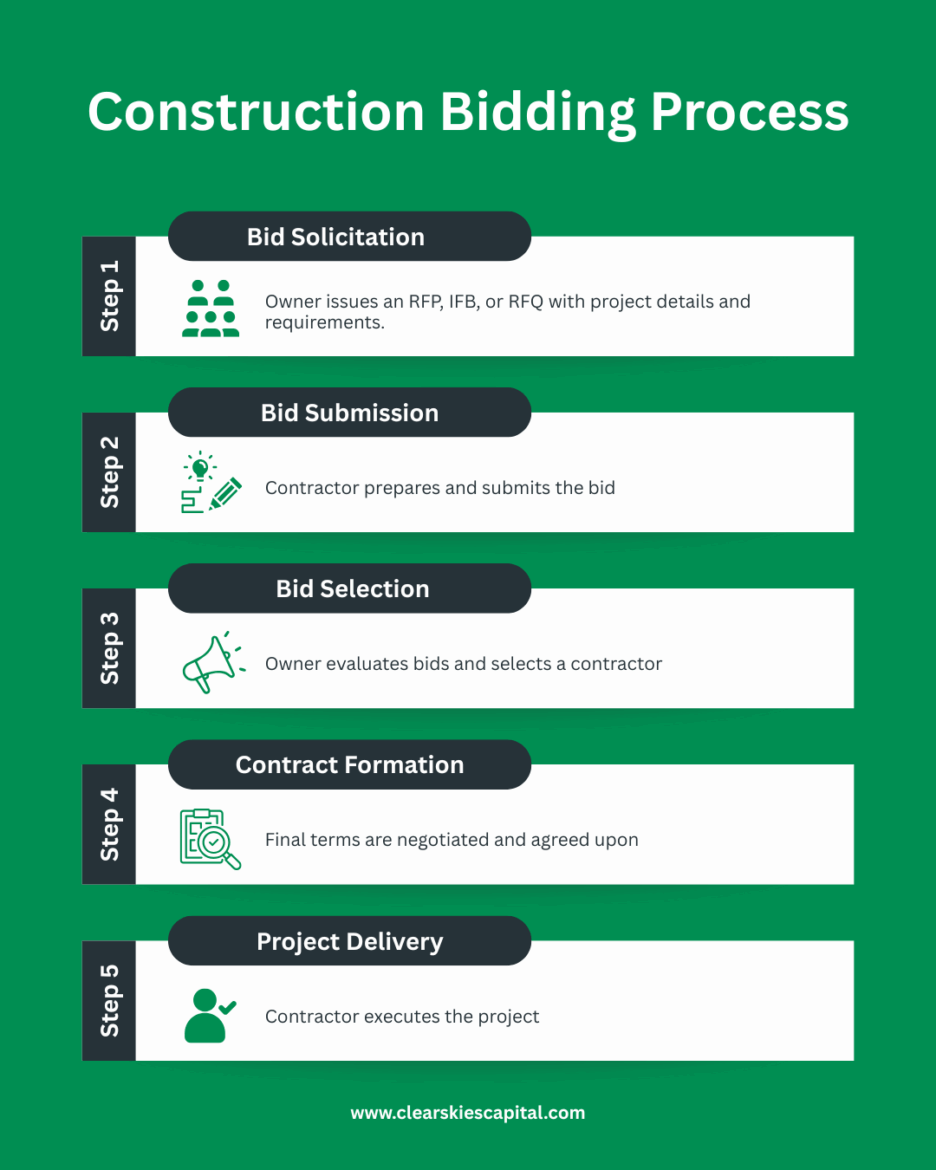
Detailed Table of the Construction Bidding Process
| Step | What Happens | Key Actions | Key Considerations |
|---|---|---|---|
| Step 1 — Bid Solicitation | Owner issues an RFP, IFB, or RFQ with project details and requirements | Review all documents, understand scope, confirm submission requirements | Missing required documents can disqualify your bid, especially on government projects |
| Step 2 — Bid Submission | Contractor prepares and submits the bid | Estimate costs (labor, materials, equipment, overhead, profit), gather sub bids, organize proposal | Presentation matters — a clean, organized bid reflects how you operate |
| Step 3 — Bid Selection | Owner evaluates bids and selects a contractor | Align bid with project priorities (price, experience, timeline, safety) | Public = lowest responsible bid; Private = multiple factors; relationships can influence decisions |
| Step 4 — Contract Formation | Final terms are negotiated and agreed upon | Review contract, negotiate pricing, payment terms, timelines, change orders | Payment structure is critical for cash flow management |
| Step 5 — Project Delivery | Contractor executes the project | Mobilize labor, materials, and equipment quickly | Costs hit before payments — strong cash flow planning is essential |
What Makes a Strong Construction Bid: Key Elements Every Contractor Needs
A strong construction bid is not just about price. It is about giving the owner confidence in your ability to deliver. Here’s what every bid should include:
→ Accurate cost breakdown — Labor, materials, subcontractor costs, equipment, permits, overhead, and your profit margin. Every line should be defensible.
→ Realistic timeline — Owners want to know when the project will be done. Overpromising your schedule is one of the fastest ways to damage a relationship.
→ Your qualifications and past work — Especially on selective or private bids, showing relevant experience and references can be as important as price.
→ Clear scope of work — Spell out exactly what’s included and what isn’t. Ambiguity in scope leads to disputes later.
→ Contingency allowance — Build in 5–10% for unknowns. Projects rarely go exactly as planned, and a contractor who eats every surprise quickly learns to overbid just to survive.
→ Professional presentation — Organized, proofread, and easy to follow. It reflects how you’ll run the job.
Financing Options to Prepare for Winning a Construction Project
Winning a bid is only the beginning. The real challenge is being ready to execute. Materials, payroll, permits, and equipment costs often hit before your first progress payment arrives. Without proper financing, even profitable bids can strain your cash flow.
Here are some common financing options contractors use to stay ready:
| Product | Best For | Funding Speed |
|---|---|---|
| Business Line of Credit | Ongoing cash flow, payroll, materials | 24–48 hours |
| Business Term Loan | Large purchases, expansion, equipment | 24–72 hours |
| Equipment Financing | Purchasing machinery, vehicles, tools | 2–5 business days |
| Revenue-Based Financing | Fast working capital, high-revenue businesses | 24–48 hours |
| SBA 7(a) Loan | Long-term working capital, lower rates | 30–90 days |
| Commercial Construction Loan | Large ground-up projects | Varies (draw-based tied to milestones) |
Private lenders typically move faster and require less documentation, while traditional and SBA loans offer lower rates for bigger or long-term projects. The right choice lets you act fast when you secure a job.
Strategies to Win More Construction Projects
Process matters, but so does strategy. The contractors who consistently win profitable work tend to share a few habits:
| Strategy | What It Means | Key Actions | Key Considerations |
|---|---|---|---|
| Bid to Your Strengths | Focus on projects where you have expertise | Target project types where you have depth (e.g., healthcare, multifamily, commercial interiors, heavy civil) | Avoid chasing every opportunity; selective bidding outperforms “shotgun” bidding |
| Build Relationships Before Bid Day | Strong relationships can influence selection | Network with owners, GCs, architects, and developers before bids are issued | Being on the shortlist before the RFP is written increases your chances of winning |
| Don’t Underbid to Win Work | Avoid lowballing just to secure a project | Know your true costs and submit realistic bids | Underbidding harms reputation and can lead to losses if costs exceed your margin |
| Ask for Clarification Early | Resolve uncertainties before submission | Use Q&A windows to clarify scope, materials, or site conditions | Making assumptions is costly; clarify before submitting your bid |
Should You Use Construction Bidding Software?
If you’re still building estimates in spreadsheets, you’re not alone. Construction bidding software helps handle the repetitive parts of the process so you can build stronger bids, faster. It’s not a must for smaller, simple jobs. But as your projects grow or get more complex, the right tool can make a big difference.
Here’s what to look for if you’re considering making the investment:
- Historical Cost Data – Save past project costs, labor, and timelines so you can reuse them. Many tools also include industry data if you don’t have your own yet.
- Digital Takeoffs – Upload plans and pull material quantities automatically. Faster and more accurate than doing it manually.
- What-If Scenarios – Quickly adjust costs and timelines when something changes. Helpful for showing clients different budget options.
- Reporting – Generate clean reports without building them from scratch. Useful for clients and internal tracking.
- Integrations – Connect with your accounting, project management, and payroll tools to avoid manual entry and errors.
- Collaboration Tools – Keep everyone aligned on larger bids with task tracking and approvals.
You don’t need the most expensive software. Start with the biggest bottleneck and solve that first.
Where to Find Construction Projects to Bid On
The best bid opportunities don’t always come to you. You have to go find them. Here are some of the most reliable sources to help you get started:
SAM.gov – The primary federal government contract portal. Free to use. Search by keyword, agency, or project type. All projects are $25,000+.
State Procurement Offices – Every state has its own procurement portal. Set up a profile and you’ll receive alerts on relevant projects in your region.
Dodge Global Network – One of the most comprehensive private project databases. Subscription-based, but widely used by commercial contractors.
iSqFt / BuildingConnected – Popular platforms for general contractor and subcontractor bid invitations. Great for building relationships in the private market.
Government vs. Private Projects
- Government jobs offer stability — they tend to remain steady when the economy slows — but they come with significantly more paperwork, longer selection timelines, and strict compliance requirements.
- Private projects move faster and can offer more flexibility, but the competition tends to be less transparent. Know the trade-offs before you commit your time to either.
Choose which type aligns with your resources, experience, and risk tolerance before committing time to a bid.
Common Construction Bidding Mistakes to Avoid
✕ Submitting incomplete bids. Missing documents or vague line items can disqualify your bid or signal disorganization to the owner. Follow the instructions exactly.
✕ Using the same numbers across every job. Formulaic bidding — applying historical percentages without reviewing the actual project — leads to costly surprises. Every project has unique conditions that affect cost.
✕ Ignoring overhead in your estimate. Insurance, admin costs, tools, trucks, and office expenses need to be baked into every bid. Overhead that isn’t accounted for comes directly out of your profit.
✕ Working with unreliable subcontractors. Your bid is only as accurate as the sub bids beneath it. If a subcontractor’s estimate is wrong or they can’t perform, it’s your project that suffers.
✕ Not tracking your results. Your bid-hit ratio tells you a lot about where your process is working and where it isn’t. Contractors who track their wins and losses improve faster than those who don’t.
Frequently Asked Questions About Construction Bids
What should a construction bid include?
A strong construction bid includes a detailed cost breakdown (labor, materials, equipment, overhead, and profit margin), a project timeline, your company qualifications and relevant past projects, a clear scope of work, and any subcontractor information. Think of it as a business proposal, not just a price quote.
What’s a good bid-hit ratio for contractors?
Industry benchmarks suggest 4:1 (one win per four bids) for private projects and 10:1 for public projects. If you’re winning too many bids, you may be underpricing. If you’re winning very few, it could be a pricing, presentation, or project-fit issue worth analyzing.
How do I estimate costs accurately for a construction bid?
To estimate costs accurately, conduct a detailed takeoff of materials, labor, and equipment using current local rates, then layer in subcontractor quotes, overhead, profit margin, and a 5–10% contingency for unknowns.
What financing options help contractors prepare for a new project?
A business line of credit is one of the most useful tools because it gives you revolving access to capital for payroll, materials, and permits before the first progress payment arrives.
Should I bid on government construction projects?
Government projects offer reliable work and can be a good source of steady revenue, especially when the private market slows down. The trade-off is more paperwork, longer award timelines, and strict compliance requirements. If you’re new to government contracting, start with SAM.gov to explore federal opportunities.
Is the lowest bid always selected?
Not always. Many public projects require the “lowest responsible bid,” which means the owner can consider whether the contractor is actually qualified to do the work. Private project owners frequently weigh experience, timeline, safety record, and past relationship alongside price. A well-prepared bid from a qualified contractor can win over a lower number from an unknown one.
Ready to Take On More Work?
Winning a construction bid is exciting but mobilizing fast matters. Materials, payroll, and equipment costs don’t wait for your first draw. Clear Skies Capital helps construction businesses secure the working capital and equipment financing they need to hit the ground running.
| Product | Amount | Speed |
|---|---|---|
| Business Term Loan | Up to $1 million | 1–3 business days |
| Business Line of Credit | Up to $200,000 | 24–48 hours |
| Equipment Financing | Up to $500,000 | 2–5 business days |
| SBA 7(a) Loan | Up to $350,000 | 45–90 days |
| Revenue-Based Financing | Up to $1 million | 24–48 hours |
→ Explore financing options at clearskiescapital.com or call us at (800) 230-9822
The information provided in this article is for educational and informational purposes only and does not constitute legal, financial, or professional advice. Contractors should independently verify project requirements, financing options, and compliance regulations before making decisions. Clear Skies Capital® is not responsible for any actions taken based on the content of this guide.
Glossary: Construction Bidding Terms Contractors Should Know
Before diving into the details of construction bidding, it helps to be familiar with some key terms you’ll see throughout this guide. Use this glossary as a quick reference while reading or when preparing your own bids.
| Term | Definition |
|---|---|
| Alternative Lenders | Non-bank financing sources that fund quickly, often with minimal documentation and no collateral. |
| Bid | A formal proposal submitted to a project owner, including price, timeline, scope, and qualifications. |
| Bid-Hit Ratio | The number of wins compared to bids submitted. Benchmarks: 1:4 private, 1:10 public. |
| Change Orders | Modifications to the original project scope, timeline, or cost after the contract is signed. |
| Contingency Allowance | Extra funds (usually 5–10%) added to a bid to cover unforeseen costs. |
| Draw Schedule | Stage-based disbursement of funds in commercial construction loans tied to project milestones. |
| Estimate | Internal calculation of project costs, including labor, materials, subcontractors, overhead, and profit margin. |
| IFB (Invitation for Bid) | A type of government bid where price is the primary selection factor. |
| Invoice Factoring / Financing | Borrowing against unpaid invoices (financing) or selling invoices outright for immediate cash (factoring). |
| Lowballing | Submitting a bid below true costs to win work, often risky. |
| Lowest Responsible Bid | The lowest-priced bid that also meets the project’s requirements for experience, capability, and reliability. |
| Mobilize | To assemble resources (labor, materials, equipment) and begin work quickly after winning a bid. |
| Negotiated Tendering | Owner selects one contractor and negotiates directly, often used for specialized or repeat-relationship projects. |
| Open Tendering | Any qualified contractor can submit a bid; common in government projects. |
| Overhead | Ongoing business expenses not tied to a specific project, such as insurance, office costs, and administrative staff. |
| Profit Margin | The percentage of revenue that remains after all project costs are covered; your earnings on the job. |
| Progress Payment | Partial payments made throughout the project based on completed work or milestones. |
| RFP (Request for Proposal) | Document issued by a project owner inviting bids, detailing project requirements and expectations. |
| RFQ (Request for Quote) | Document requesting pricing for a specific scope of work. |
| SBA 7(a) / 504 Loans | Government-backed loans for working capital, equipment, or owner-occupied real estate. |
| Scope of Work | Detailed description of tasks, responsibilities, and deliverables for a project. |
| Selective Tendering | Owner invites a shortlist of pre-qualified contractors to bid. |
| Serial Tendering | Bidding on a series of similar projects over time; rewards consistency. |
| Sub Bids | Quotes or estimates provided by subcontractors for their portion of the project work. |
| Subcontractor | A separate contractor hired to perform part of the project under the main contractor. |
| Takeoff | The calculation of all physical materials and labor required for a project based on the provided architectural plans. |
| Tendering | The process by which a project owner invites contractors to submit bids. |
| Working Capital | Cash available to cover day-to-day operational costs like payroll and materials. |